Here is one more system of Vibrato. If the reader is tempted to smile, I can assure him that I smile with him. I am merely trying to express to the reader the principles to which he appeals when he smiles.
Paraphrasing George Santayana
Vibrato Revisited II
BALANCING, HUNTING, PLAYING, MATING
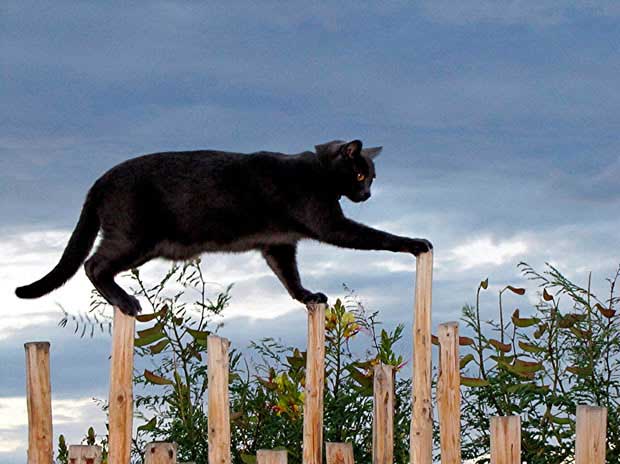
a) Locating and establishing the optimal point of pressure for each finger
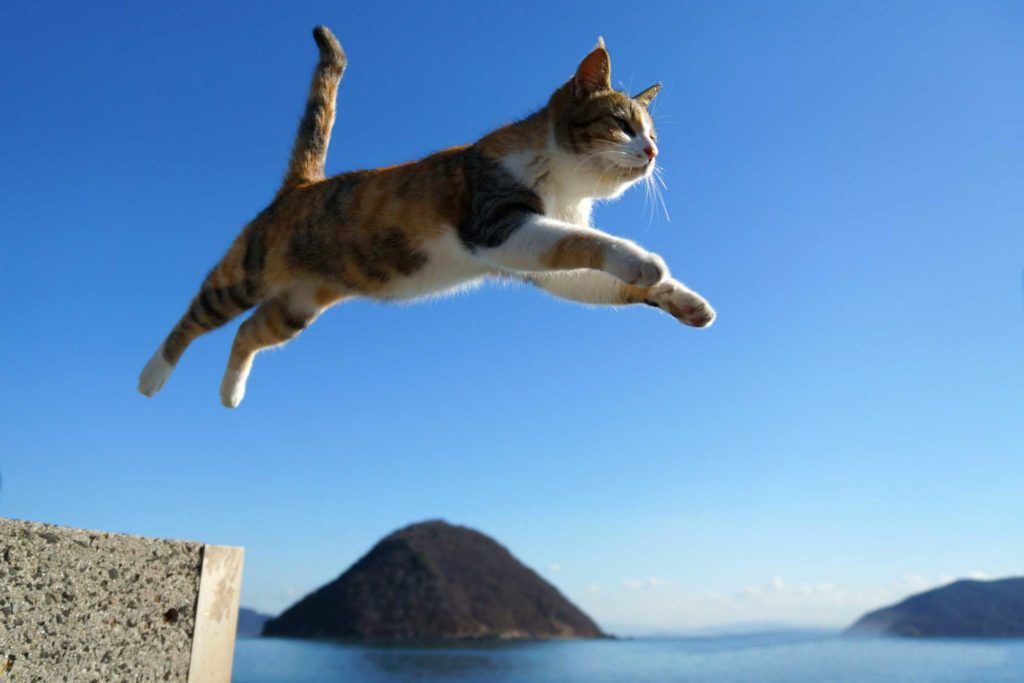
In this exercise we concentrate on balancing each finger in such a way that the point of pressure always remains the same, especially when the finger pivots to and from thumb position – it is this pivoting act that helps us exactly define this point. Tonal precision and quality depend immensely on a well balanced finger on the string. Once this exercise is completed the fingers will actually demand to be positioned on their optimal spot, which is an important step towards producing a homogeneous and balanced tone. We should ensure that for each finger performing this balancing act, the other fingers follow it precisely, on their own optimal spots, just like a cat’s paws on a fence.
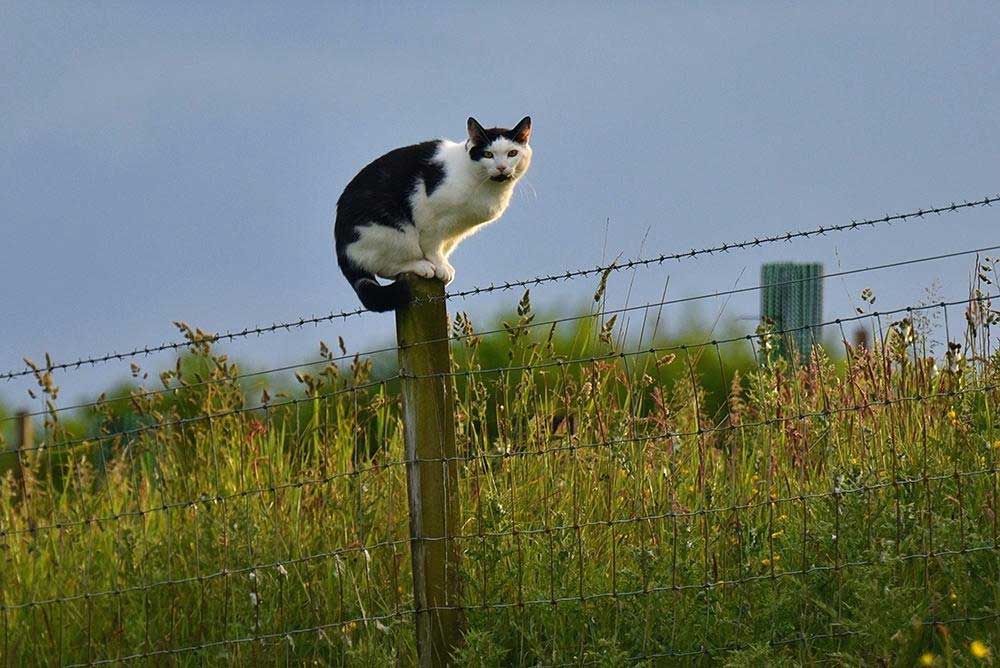
b) Locating and establishing the optimal point of pressure for each finger, in a vertical sense
01 The sus 4 7 chord on all four strings
In this exercise we move away from the concept of linear movement. The open strings of the double bass, when played together, produce an E sus47 chord. Consequently, when the strings are simultaneously pressed down at the same point, they produce Fsus47, F#sus47, Gsus47 and so on, moving chromatically upwards.
We start on the note G (on E string). To save time I will be moving up in whole-tone steps in the video but chromatic steps are recommended. I would even suggest the simultaneous use of a musical device playing the sus47 chords for intonation purposes. Our main targets are good intonation and quality of tone on all four fingers. These require precision from each finger and is another way of establishing the optimal spot in string crossing.
02 Locating the optimal pressure point by using the sus 4 7 Chord on Neck Position
03 The sus 4 7 chord in Neck Position
04 The sus 4 7 chord in Intermediate Position
05 The sus 4 7 chord in Thumb Position
We try very carefully to maintain the same point of pressure from string to string.
A few examples of each position are displayed here but trying all positions is recommended.
c) Squeezing a little more usefulness out of the previous idea
06 Bending of first finger joint,while playing the sus 4 7 chord
While playing the sus47 chord with all four fingers, our hand assumes a position in relation to the neck, which is actually the hand position required for the Intermediate Position Vibrato (see Vibrato Revisited I). Now check that the first joint is bending – this is necessary for executing this type of vibrato.
d) And yet a little more usefulness
07 "Boney" and "Fleshy" pressure points
The two extremes of the bending action establish two more points of pressure. A boney one when the knuckle is bent and a fleshy one when the knuckle is straightened out. Notice that these two pressure points give two different tone qualities. Through this cycle of exercises, with patience and attention to detail, one acquires “awakened” fingers, each one having a clearer vision of its role in music making and each being readier to cooperate harmoniously with the others.

a) Moving on with repertoire examples
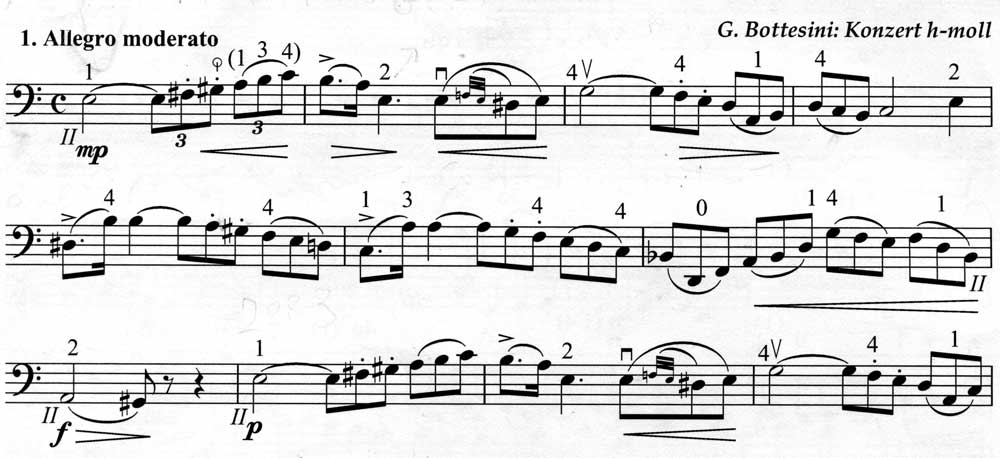
08 Locating the optimal pressure point for specific notes through slides
This is our first foray into the real world and for this we will take the first eight bars of Bottesini’s second concerto (Allegro).
Before we start playing the music, we should remind our fingers of their optimal posture by small slides, upwards and downwards. Each finger should arrive at the proper pitch. This brings back the desired awareness. If done properly, we should have three or four nicely aligned fingers, ready to move smoothly and freely, and most importantly, ready to perform vibrato. The type of vibrato we are going to use in this example is the Intermediate Position Vibrato, which means that the fingers are slightly canted so that the first joint contributes to the vibrato production.
09 Bottesini Allegro on D string
The music is going to be used as an exercise; that is to say that we are going to perform it on various strings, starting first on D string, then on A string. Finally, we shall play normally on G string. The tempo is going to be significantly slower than in a normal performance, so we can observe and control in detail our vibrating fingers. For now, and irrespectively of style and tastes, we are going to play in a continuous vibrato style. At this point, we should not be forgetting that vibrato is performed using the whole palm and that means a continuously vibrating hand. Each finger succumbs to this vibrating movement. This allows the vibrato to exist even on the shortest notes. At bars 2, 5 and 6 the finger should land quickly on the note after the shift while maintaining the vibrato and not starting a new vibrato movement.
10 Bottesini Allegro on A string
In order to achieve the same vibrato effect on a thicker string, a wider movement is required. This is an element that we are going to use extensively later on in order to achieve various aesthetic or dynamic results.
11 Bottesini Allegro on G string
It is important to keep fingers carefully aligned and as close as possible above the strings when not in use. We perform these exercises in order to achieve the utmost readiness in each finger, and consequently optimise smoothness, tone control and agility.
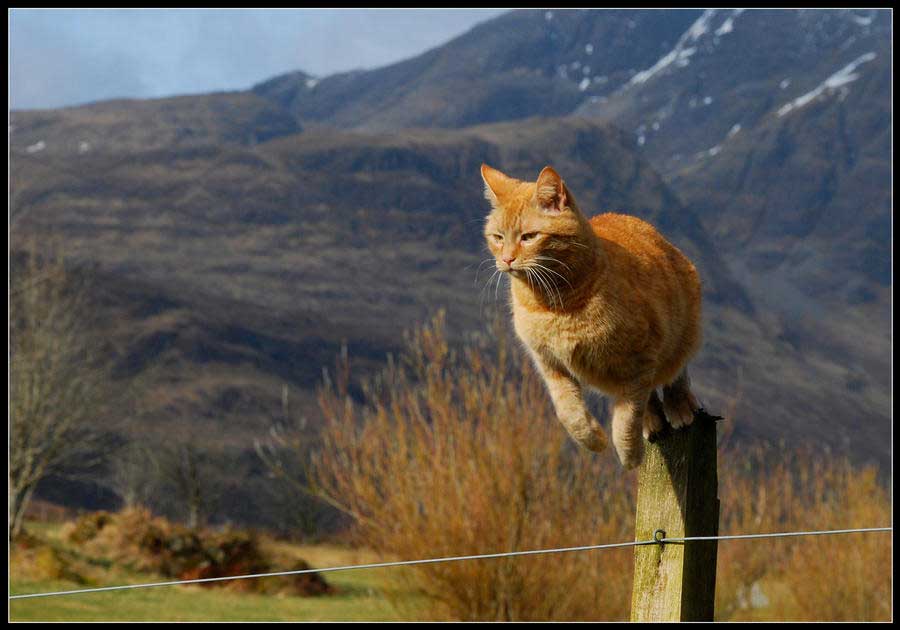
1) We shall play the first eight bars without vibrato but still molto espressivo in two variations:
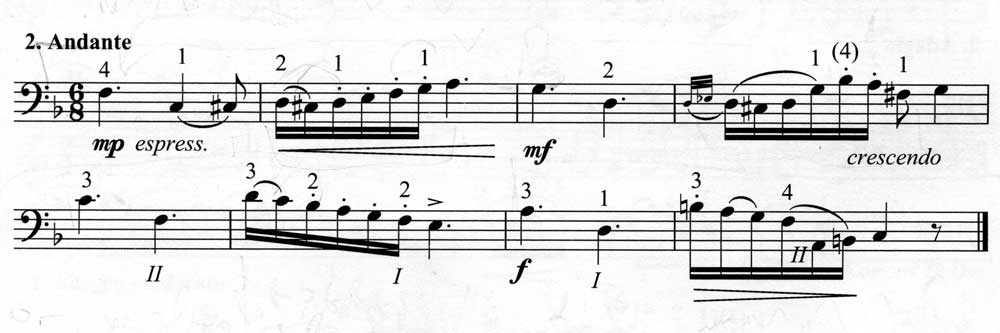
12 Bottesini Andante no Vibrato on D, A, G string
• Neck Position Vibrato
13 Bottesini Andante no Vibrato on D,A,G strings
• Intermediate Position Vibrato
so as to explore the differences in tone quality produced by two different vibrato types.
In both cases, we respect the dynamic indications, i.e. a continuous crescendo.
2) As a next step, we shall attempt to play the same part but in a special way:
14 Bottesini Andante Crescendo through increasing Vibrato width on D,A,G strings
• bars 1 2: no vibrato
• bars 3 4: narrow vibrato
• bars 5 6: normal vibrato
• bars 7 8: wide vibrato
The speed of vibrato remains the same throughout the exercise. The dynamic should also remain constant, which means no dynamic crescendo throughout the passage. We attempt to create a form of expressive crescendo only through the constantly increasing width of the vibrato.
Here it is shown that vibrato width can be used as a tool for increasing or decreasing the intensity of a passage. Or, to put it in other words, the differentiation of vibrato width is an expressive tool.
3) Sampling vibrato from a thicker string.
17 Sampling Vibrato width from a thicker string
That means that if we play the Bottesini andante example like this:
bars 1 2 on G string
bars 3 4 on D string and transfer the unaltered effect on G string
bars 5 6 on A string and transfer the unaltered results on G string
bars 7 8 on E string and transfer the unaltered results on G string
we develop a system of transferring the specific vibrato widths from the thicker strings, giving us a variety of widths on the G string.
4) The next step will be to try to produce a crescendo effect only through vibrato speed. Again, the dynamic remains constant.
15 Bottesini Andante Crescendo through Vibrato Speed on D,G,A strings
bars 1 2 no Vibrato
bars 3 4 moderately fast Vibrato
bars 5 6 fast Vibrato
bars 7 8 very fast Vibrato
Dynamics remain the same.
5) The next step of this cycle will be the examination of:
16 Bottesini Andante Crescendo through less & less delayed Vibrato on A,G strings
- bars 1 2 vibrato long after the note attack
- bars 3 4 vibrato shortly after the note attack
- bars 5 6 vibrato on the attack of the note
- bars 7 8 vibrato before the attack of the note
Dynamics remain the same.
6) Sampling Vibrato from lower notes on the same string
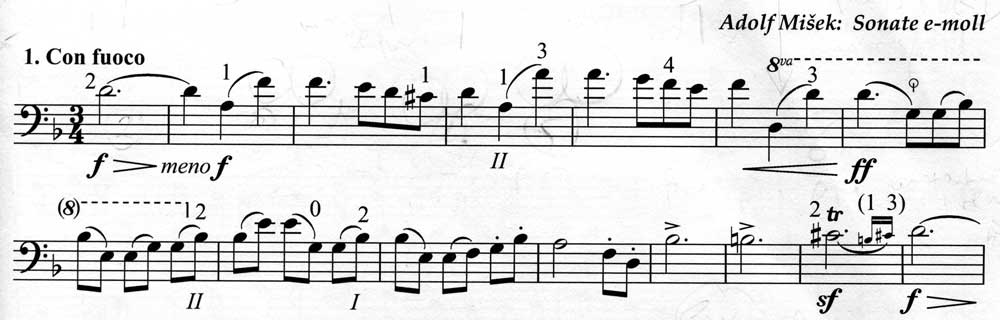
18 Misek Con Fuoco on D,A,G strings
The next victim to whet our appetite for games will be Misek’s second Sonata (con fuoco). From this, we snatch the first seven bars. We shall attempt to sample vibrato width from a lower note on the same string.
- bar 2 sample from A → F
- bar 4 sample from A → A
- bar 6 sample from D → D
Each time the interval gets bigger. That means that transferring the vibrato width from say La → La will make a bigger difference than from La→ Fa.
Note that the upbeats of F, A, and D, also F, A, D belong to the same family of tone as the following downbeat notes. This could safely be followed as a general rule when shaping a phrase.
7) Some more abuse of Misek’s “con fuoco”, now playing with vibrato speed.
19 Crescendo through Vibrato speed
20 Misek Con Fuoco sampling vibrato from lower notes on the same string on D,G strings
Before playing the passage, we first try a few single notes in a row. This should be done on all fours strings.
• A = approximately 2 oscillations per beat
• D = approximately 3 oscillations per beat
• F = approximately 4 oscillations per beat
• A = approximately 5 oscillations per beat
• D = approximately 6 oscillations per beat
I should stress that, here, the beat is not a metronomic value but rather a pulse to be felt – a personal unit of vibrato frequency.
8) Our last game will be about how late, if at all, the vibrato begins after the note has started.
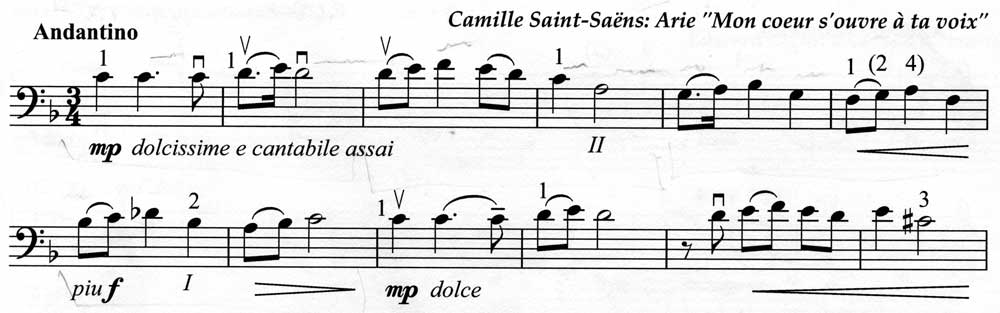
21 Saint Saens delayed Vibrato
• Bars 1-2 Vibrato long after the note
• Bars 3-4 Vibrato after the note
• Bars 5-6 Vibrato on the note
• Bars 7-8 Vibrato before the note
This exercise aims at making clear that the choice of the moment that vibrato comes in when a note is played is an aesthetic choice rather than a habit or a mannerism. It is probably one of the most important ways to shape our personal style and approach to a given composition.
Finally, we have reached a point where the combinations of vibrato elements seem limitless. The challenge here is how to navigate through often these imperceptible yet important details since they contribute immensely to the shaping of the fine texture in our playing.
If someone wonders whether a similar approach demands longer practicing sessions I could simply answer that using the vibrato element in a systematic way could actually reduce practicing time since it helps us navigate towards the final shaping of any phrase.

Mating time has arrived! I mean the time has come to mate the various vibrato elements we have discussed thus far: a synthesis of width, speed and delayed vibrato effects contributing to the shaping of the musical phrasing and idea.
a) Bottesini Elegia in re:
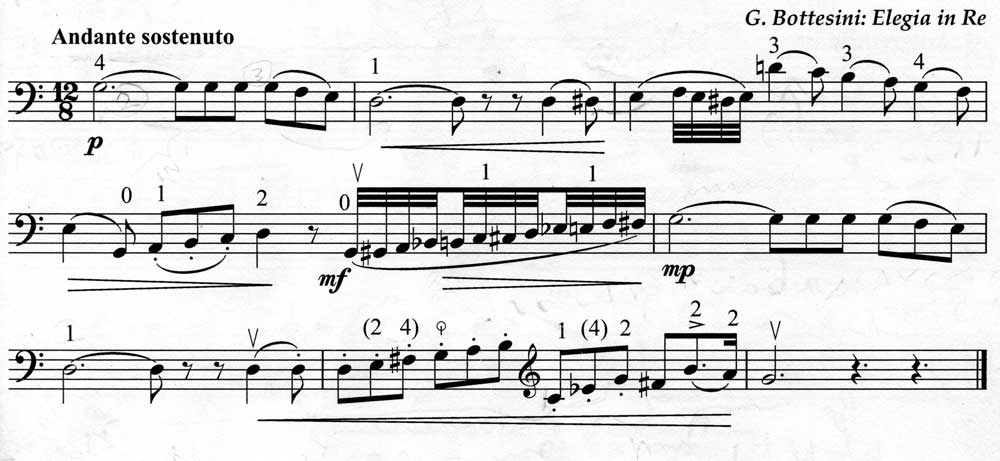
22 Bottesini Elegia in Re combination of Vibrato elements in shaping the musical phrase
Bar 1. The indicated fingerings are as always a mere suggestion. We start with the second finger and no vibrato. Vibrato can come in on approximately the second beat. The eighth-notes are vibrated from their beginning. On the fourth beat of the first bar we can change to third finger, increasing also the vibrato width just to give some extra stress on this note.
Bar 2. The long note can be played with slightly delayed vibrato. The width of vibrato can also delicately be increased during the note’s duration, to follow the dynamic indication. Vibrato on the last beat starts on the note and this character remains the same throughout the example.
Bar 3. Interestingly enough, the whole bar is played on D string, a selection that facilitates an effortless shift and a sweetness of tone.
Bar 4. Also played on D string for the same reason
Bar 5. Still on D string, the initial G played with vibrato on the note
Bar 6. Still on D string
Bar 7. Still on the D string up to C
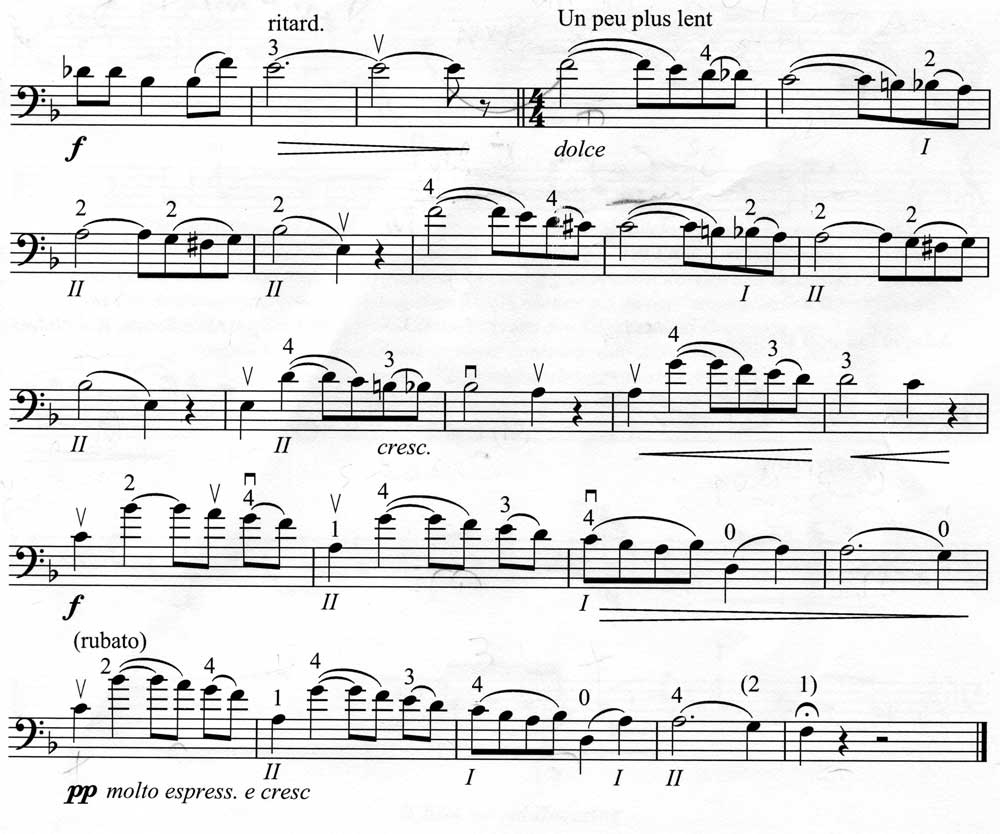
Before being considered “heretical”, I will provide one or two arguments. In this bar we have crescendi by all means. Tonal crescendo, dynamic crescendo and possibly, according to this method, a vibrato crescendo. The first half of the bar consists of a scale. The second half consists of an arpeggio just at the place where things become a little tough (I am sure that Bottesini would have managed, in his own special way, perfectly).
b) Misek Andante cantabile
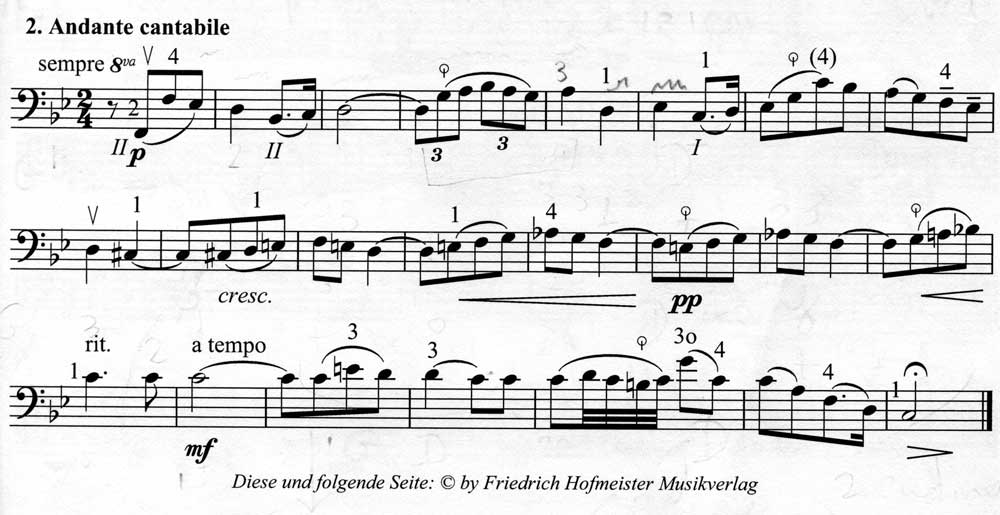
Don’t shy away from thumb vibrato on lyrical passages.
We shall use the first 23 bars. Here we choose to give a rather restrained character, in a way introverted, with passion that despite the fact that it is there, it never reveals itself entirely. This, among other things, that a very judicious use of vibrato is required. In the same direction, we are going to use Normal Position Vibrato, the upright fingers helping also to the direction of a simpler, innocent tone.
23 Misek Andante variations of Vibrato elements in forming the aesthetics
- Bar 1. Strings A-D. We can start with no vibrato at all, just giving some pulse to the last Eflat, leading to th next bar.
- Bar 2. The D note can be played with a delayed vibrato, normal speed and discreet.
- Bar 3. The long D coming as a confirmation of the previous D of Bar 2 can be played with
after the note vibrato, consistently leading to the next bar. - Bars 4-5. In these two bars, after the note vibrato is used throughout, so that in
- Bars 6-8. The use of on the note vibrato contributes to a slight increase of intensity. Vibrato
speed remains the same, vibrato width increases a bit, and this will enable us to make a clear contrast in
- Bar 9. Where with C# a darker mood slips in. Actually, we can start C# with no vibrato at all,
just to add very little on
- Bar 10. From there on, up to
- Bar 13. We maintain an on the note vibrato with constant increase of vibrato width that
follows the crescendo indications. This should be done sparingly on Bar 10 In
- Bar 14. Although this is a repetition of
- Bars 12-13. The character should be that of a ghost, not just an echo. Pail, lifeless. No vibrato,
of course, along with thinning out of the tone. Vibrato comes in again on F on
- Bar 16. Vibrato width can follow the crescendo indication sparingly.
- Bars 16-18. Are played on the D string, in the interest of a less dramatic style. One more
reason for staying around the D string is the effortless realization of Bar 21
C) Saint-Saens “Mon coeur s’ouvre a ta voix”
We shall use the un peu plus lent part of the Aria. We shall take its first bar as bar 1. This is a melody of great emotional intensity. It requires a true involvement from the part of the performer. Thus, despite the fact that I will describe in detail the variations of vibrato that can be used, an effort should be made so that the final result sounds as if the performer has made these choices spontaneously. In a nutshell, this is an example of how to use our vibrato pallet creatively.
24 Saint Saens varying Vibrato elements in the interests of musical content
- Bar 1. The F note can begin with no vibrato and start vibrating on the 3rd beat.
- Bar 2. The C note can start vibrating on the 2nd beat, a little earlier than the F did previously.
- Bars 3-4. The A starts even earlier, before the 2nd beat. Up to here, we can use N.V.P. for achieving a clean, simple tone.
- Bars 5-7. The same idea is presented here in greater intensity. We use I.P.V. and now the vibrato starts just after the notes.
- Bars 9-13. Here we have a climax building up, the peak being on Bar 13. We use vibrato on
the note and we progressively increase both vibrato width and speed. Additionally, on - Bar 13. The C can be played with an increasing vibrato width in order to anticipate the vibrato
of Bflat and enhance the feeling of continuity of vibrato. Furthermore, on - Bars 13-15. We can use vibrato before the note to further distinguish these notes.
- Bars 14-16. will be played with gradually decreasing vibrato width and vibrato speed, keeping
up with the intensive character nevertheless. - Bars 17-21. Can be played in a manner sounding detached, almost exhausted after the emotional breakdown that preceded them. We use Thumb Position for total differentiation. Slightly pulsing fingers indicating remains of passion up to a relieved closure.
It is considered good practice always to play any passage first without vibrato. The tone and dynamics should be there already. The musical result should be valid at any time, even if we are playing a piece that for historic, stylistic or compositional reasons asks for vibrato.
Vibrato is a tool for quality of tone (when barely perceptible), character and expressive power.